Research since the late 1980s documents the empirical regularity that the slope of the yield curve is a reliable predictor of future real economic activity. Today, a substantial body of evidence exists from which various useful stylized facts have emerged.
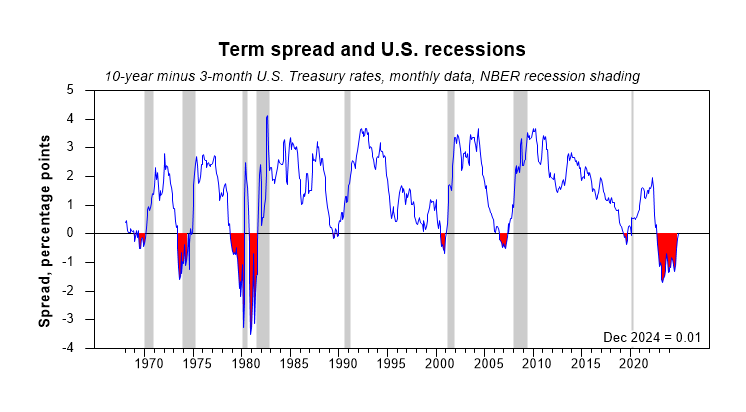
Benchmark 10-year minus 3-month spread
Since 1968, the spread between 10-year and 3-month Treasury rates, which is normally positive, has inverted (turned negative) before each of the eight officially-dated U.S. recessions, as the graph shows. Most recently, the spread has been inverted since November 2022.
Other spreads
Research suggests that spreads between other pairs of interest rates along the yield curve contain useful information, but are not as reliable for predicting recessions as the 10-year 3-month spread. Two of the better known alternatives are illustrated in the graph below.
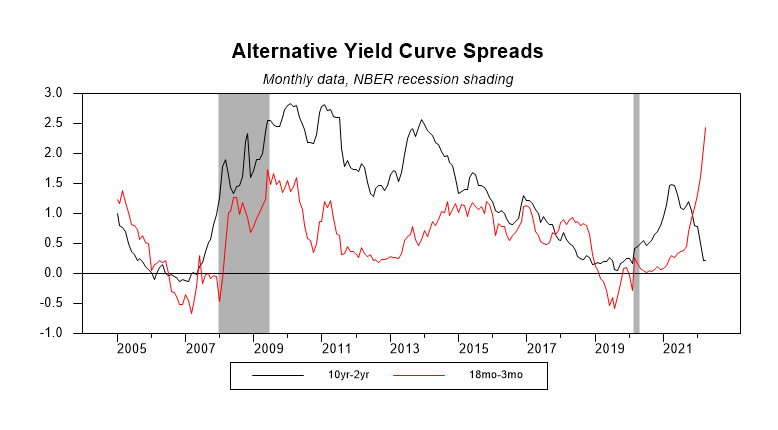
The spread between 10-year and 2-year Treasury yields seems to be the darling of the financial media, perhaps under the impression that any two points along the curve can work just as well. In truth, this spread has a spotty history in connection with recent recessions and the monthly average did not invert at all before the 2020 recession.
Another alternative favored by Federal Reserve Chair Jerome Powell is the difference between a 3-month Treasury forward rate 18 months ahead and a discount basis 3-month Treasury bill rate. This spread has assumed low values even in expansionary periods, sometimes approaching the level of a recession signal. For example, from 2011 to 2013, the spread was very low but a recession did not materialize.
For more detailed analysis, see Discussion Paper No. 2201.